Coating Challenges in Medical Device Manufacturing
Medical devices often combine small dimensions, complex geometries and tightly controlled functional surfaces. The coating process may need to deposit material on a selected area while limiting unnecessary exposure of adjacent features.
Common process challenges include:
- Coating small or geometrically complex components
- Controlling the coated length and spray boundary
- Processing low-volume or high-value coating formulations
- Maintaining repeatable nozzle-to-part distance and motion
- Coating cylindrical components around their circumference
- Developing a process that can later be transferred from R&D to production
- Integrating coating, motion, liquid delivery and process control into one system
Coating integrity must ultimately be evaluated as part of the finished medical-device process. For coated vascular devices, FDA guidance specifically discusses coating characterization, integrity and durability rather than treating visual appearance alone as sufficient evidence. FDA guidance on intravascular stents
Medical Device Coating Applications
Stent Coating
Ultrasonic spray technology can be incorporated into systems designed to coat small, open-structure components such as vascular stents.
Depending on the process requirements, the system may combine focused atomization, controlled liquid delivery, part rotation and programmed axial movement. Masking or dedicated fixturing may also be required when only selected surfaces or sections should be coated.
Potential coating objectives include:
- Drug-carrier or polymer layers
- Functional surface coatings
- Hydrophilic or hydrophobic layers
- Research coatings for material and process development
Material compatibility, coating performance and release characteristics must be established through application-specific testing.
Balloon Catheter Coating
Balloon catheters require coordinated control of the spray pattern, coated length, part rotation and nozzle movement.
A coating platform may be configured for:
- Defined balloon coating lengths
- Circumferential coating
- Multiple programmed passes
- Controlled liquid delivery
- Recipe-based motion sequences
- R&D or pilot-scale process development
The final configuration depends on balloon material, dimensions, target area, coating formulation and required throughput.
Catheter and Guidewire Coating
Focused ultrasonic nozzles can be integrated with linear and rotational motion for coating elongated medical components such as catheter shafts and guidewires.
Typical process objectives may include:
- Selective distal-section coating
- Lubricious or functional surface layers
- Controlled start and stop positions
- Repeatable circumferential coverage
- Reduced handling through automated motion
Lubricious coatings are commonly used on intravascular catheters, guidewires and delivery systems, but their safety and performance depend on formulation, manufacturing, integrity testing and intended use—not on the spray method alone. FDA guidance on lubricious coatings
Diagnostic Tubes and Medical Consumables
Ultrasonic spray systems can also be adapted for coating selected internal or external surfaces of diagnostic tubes and other medical consumables.
Possible configurations include:
- Internal-wall spraying
- External surface coating
- Fixed or moving nozzle arrangements
- Single-part or indexed processing
- Custom fixtures for different tube sizes
Feasibility should be evaluated according to tube geometry, opening diameter, coating depth, liquid properties and required coated area.
Implants and Precision Components
For implants and other precision components, the coating system can combine ultrasonic atomization with multi-axis motion, part rotation or custom fixturing.
Because implant geometries and coating requirements vary substantially, system design should begin with a sample and process assessment rather than a standard machine selection.
How Ultrasonic Spray Coating Works
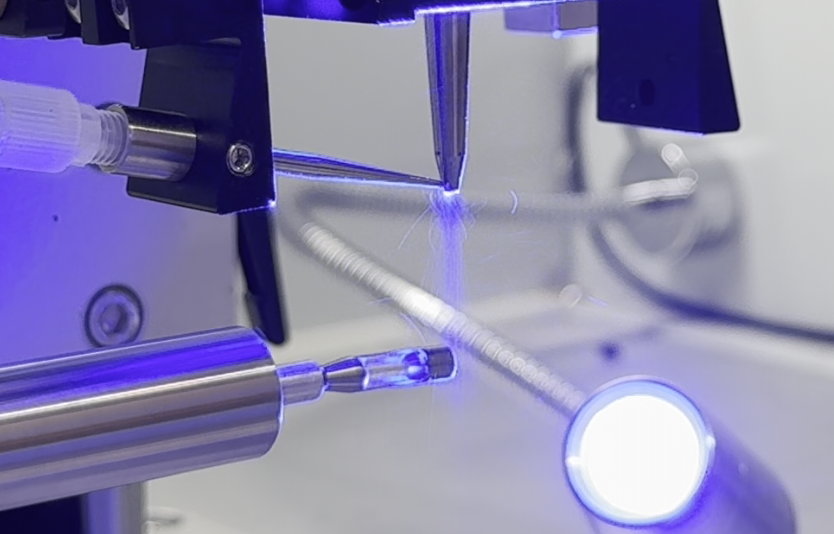
An ultrasonic nozzle uses high-frequency mechanical vibration to atomize a liquid into a controllable mist.
A small amount of shaping gas may then be used to direct and shape the droplets toward the target. Unlike conventional pneumatic spraying, the liquid is not atomized primarily by high-pressure air.
A typical medical-device coating process includes:
- The coating liquid is delivered to the ultrasonic nozzle.
- Ultrasonic vibration atomizes the liquid at the nozzle tip.
- Shaping gas directs the mist toward the selected area.
- The nozzle or component follows a programmed motion path.
- Multiple passes may be applied according to the validated process.
- The coated component proceeds to drying, curing or further processing as required.
Why Use Ultrasonic Spray Technology?
Controlled, Low-Velocity Atomization
Ultrasonic atomization produces a controllable mist without relying on high-pressure air as the primary atomization mechanism. This can be useful when coating delicate or small components.
Focused Spray Configurations
Focused nozzles and shaping-gas arrangements can be selected for narrow coating areas, small components and selective spray paths.
Motion-Control Integration
Rotation, linear travel and multi-axis motion can be coordinated with liquid delivery and spray control to create repeatable coating sequences.
R&D-to-Production Scalability
The same process principles can be developed on a laboratory platform and transferred to a larger automated system, subject to scale-up testing and process revalidation.
Custom Fixtures and Process Control
Fixtures, masks, nozzle position, liquid path and software recipes can be adapted to the specific component and coating objective.
System Configurations
Laboratory Coating Platform
Suitable for:
- Feasibility studies
- Formulation screening
- Process-window development
- Small sample batches
- University and medical-device R&D
Possible configuration:
- Single ultrasonic nozzle
- Programmable syringe pump
- Manual or programmable motion
- Sample holder or simple rotation fixture
- Basic recipe control
Pilot Coating System
Suitable for:
- Process optimization
- Engineering verification
- Pilot batches
- Scale-up studies
- Pre-production development
Possible configuration:
- Focused or wide-area nozzle
- Programmable rotation and linear motion
- Enclosed coating chamber
- Recipe management
- Process parameter recording
- Custom component fixtures
Automated Production System
Suitable for:
- Repetitive production processes
- Multi-step coating sequences
- Automated component handling
- Integration with upstream or downstream equipment
Possible configuration:
- Multi-axis motion
- Multiple nozzles
- Automated loading and unloading
- Vision or position detection
- Exhaust and enclosure interfaces
- Production data integration
From Sample to Coating Solution
- Application Review
We review the component geometry, substrate, coating liquid, target area, required throughput and production environment.
- Feasibility Evaluation
Where appropriate, representative samples and coating materials are used to assess nozzle selection, liquid delivery, motion and fixture requirements.
- Process Development
Key parameters may include liquid flow rate, nozzle power, shaping gas, spray distance, motion speed, rotation speed and number of passes.
- System Configuration
The coating platform is configured according to the confirmed process requirements, including nozzle type, motion axes, fixtures, enclosure and controls.
- Customer Validation
The customer remains responsible for validating the final coating process, material compatibility, biological safety, sterilization compatibility and regulatory compliance for the intended medical device.
Information We Need for System Selection
Please provide:
- Medical device or component type
- Component material
- Dimensions or technical drawing
- Internal, external or selective coating area
- Coating liquid or formulation type
- Viscosity and solids content, if available
- Required coating length or area
- Desired batch size or production rate
- Laboratory, pilot or production use
- Required motion, enclosure or automation
- Available samples for testing