Ultrasonic Spray Coating for Perforated Plates: Improving Uniformity Without Blocking Pores
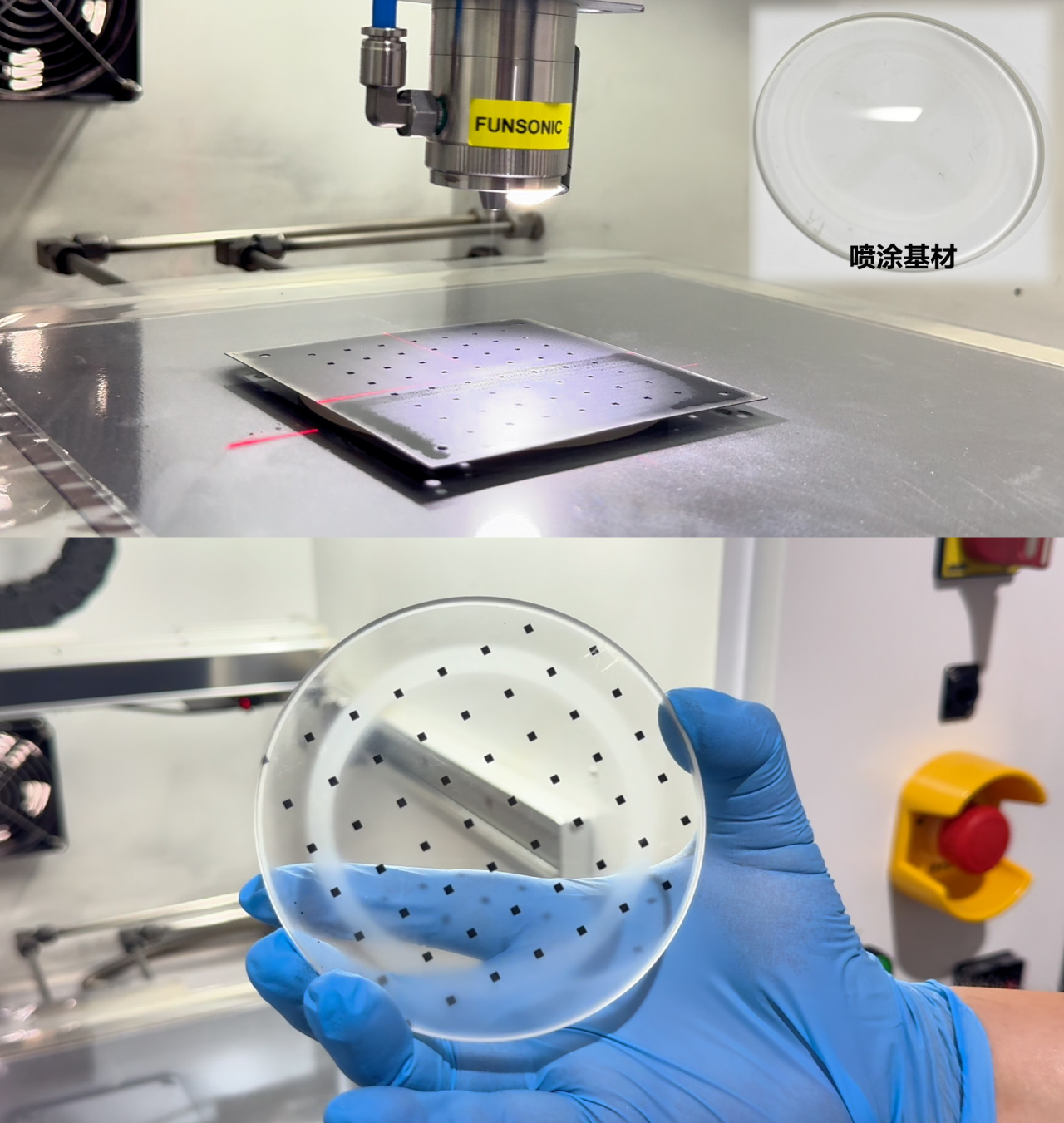
Perforated plates and porous substrates are used in filtration, electronics, catalyst supports, energy devices, and other functional coating applications. Their open structure makes coating difficult: liquid can collect around pore edges, miss recessed surfaces, or block pores when the deposition rate is too high.
Ultrasonic spray coating provides controlled atomization at a relatively low spray velocity. With the correct liquid formulation, nozzle setup, motion path, and airflow, it can help improve coating control and reduce overspray. It does not, however, guarantee complete coverage inside every pore. Sample testing remains essential.
Why Perforated Plates Are Difficult to Coat
- Edge buildup
Droplets may accumulate around pore openings, creating a thicker rim than on the flat surface.
- Incomplete internal coverage
Small diameter, high aspect ratio, poor wetting, or trapped air can limit penetration into pore walls and recessed areas.
- Pore blockage
High flow, large droplets, particle agglomeration, or too many wet passes can partially close the pore structure.
- Material loss
Uncontrolled spray momentum and an unsuitable spray pattern can increase overspray and rebound.
- Narrow process window
Small changes in viscosity, solids loading, drying rate, or motion speed can alter coating weight and uniformity.
How Ultrasonic Spray Coating Can Help
- Controlled atomization
Ultrasonic vibration produces a fine spray without relying on high-pressure atomizing air. Actual droplet size depends on frequency, liquid properties, flow rate, and nozzle design.
- Low-velocity deposition
Lower droplet momentum may reduce bounce and splashing on delicate or open structures.
- Precise liquid delivery
Metered flow and programmable scanning make it easier to control coating weight, overlap, and the number of passes.
- Automation options
XY or XYZ motion, substrate rotation, heating, vacuum holding, and enclosed spraying can be configured according to part geometry and process requirements.
(Important limitation: Deep or high-aspect-ratio pores may still be difficult to coat uniformly. Wetting, solvent evaporation, airflow, spray angle, and pore geometry can matter more than atomization alone. Multi-angle spraying, part rotation, vacuum assistance, or another deposition method may be required.)
Key Parameters for Porous-Substrate Coating
| Parameter group | What to confirm | Why it matters |
|---|---|---|
| Liquid formulation | Viscosity, surface tension, solids loading, particle size, dispersion stability | Determines atomization, wetting, drying, and blockage risk |
| Flow and atomization | Liquid flow, frequency, amplitude or power, carrier gas if used | Affects droplet formation, spray stability, and deposition rate |
| Geometry | Pore diameter, depth, open-area ratio, plate thickness, surface condition | Determines accessibility and required spray angle |
| Motion | Distance, angle, scan speed, overlap, passes, rotation | Controls coverage distribution and coating weight |
| Environment | Substrate temperature, drying rate, enclosure, exhaust, humidity | Influences spreading, solvent evaporation, and defects |
Typical Application Directions
- Filtration and separation components
Protective, hydrophilic, hydrophobic, or other functional coatings on perforated plates, screens, and porous supports.
- Catalyst and energy materials
Deposition of catalyst-containing inks or functional slurries on selected porous components, subject to formulation and pore-structure testing.
- Electronic and precision metal parts
Conductive, dielectric, protective, or release coatings on perforated foils and patterned components.
- Biomedical and microfluidic components
Surface modification on selected wells, pores, or channels where material compatibility and cleanliness requirements can be met.
Frequently Asked Questions
- Can ultrasonic spraying coat the inside walls of every pore?
Not automatically. Internal coverage depends on pore size, depth, aspect ratio, wetting, airflow, and spray access. A cross-section inspection after sample testing is recommended.
- Will ultrasonic spray coating prevent pore blockage?
It can improve liquid-flow control and reduce unnecessary deposition, but blockage risk also depends on droplet size, solids loading, particle agglomeration, drying behavior, and coating target.
- What should be supplied for an initial evaluation?
Provide the plate material and dimensions, pore diameter and depth, open-area ratio, coating liquid data, target coating area, thickness or loading, acceptable blockage level, and required throughput.
Evaluate Your Perforated-Plate Coating Process
FUNSONIC can support ultrasonic spray system configuration for perforated plates and porous substrates. Final nozzle selection, motion design, and process parameters should be based on material data and sample testing.
For an initial recommendation, provide: substrate drawing, pore geometry, coating formulation, target coverage, thickness or loading, blockage limit, part size, and production capacity.